
Upgrade your car’s sound system with top-tier speakers for an essential music boost. This guide simplifies choosing and installing the best car speakers to elevate your driving soundtrack. Get ready for clearer highs, deeper lows, and an immersive audio experience on every journey.
Is your car’s music sounding a little… flat? You crank up your favorite song, and instead of a rich, powerful audio experience, you get tinny notes and a lack of oomph. It’s a common frustration for many drivers who love their tunes but are stuck with factory-installed speakers. The good news is, you don’t need a professional installer or a massive budget to significantly improve your car’s stereo system. We’re here to guide you through understanding what makes a great car speaker and how to pick the perfect ones to give your music the boost it deserves. Get ready to transform your daily commute into a concert hall on wheels!
Why Upgrading Your Car Speakers Matters
Think of your car’s audio as a chain. The head unit (your radio/infotainment system) is the source, the amplifier gives it power, and the speakers are the final output – the part that actually creates the sound you hear. If your speakers are the weakest link, no matter how good your head unit is, the sound quality will suffer. Factory car speakers are often designed with cost in mind rather than premium audio performance. They might be small, made with less durable materials, and lack the range to reproduce music faithfully.
Upgrading your speakers means:
- Experiencing more detail: Hear nuances in music you never noticed before.
- Enjoying a wider frequency range: Get punchy bass and crisp, clear high notes.
- Achieving a fuller sound: Music will sound richer and more immersive.
- Reducing distortion: Enjoy louder volumes without the unpleasant crackling or muddiness.
Understanding Speaker Basics: What to Look For
To make an informed choice, let’s break down some key speaker terms and features. Don’t worry, we’ll keep it simple!
Speaker Size and Fitment
This is the most crucial starting point. Car speakers come in standard sizes (e.g., 6.5 inches, 5.25 inches, 6×9 inches) and shapes (round or oval). You need to know what fits your car’s existing openings. To find this out:
- Check your car’s manual: It often lists speaker sizes.
- Research online: Websites like Crutchfield have vehicle-specific fitment guides where you can enter your car’s make, model, and year to see compatible speakers.
- Measure existing speakers: If you’re comfortable, carefully remove your current door panels to measure the cutout diameter of your existing speakers.
Remember, sometimes a slightly different size can be made to fit with adapter plates, but sticking to the factory size is usually the easiest route for beginners.
Speaker Types
Car speakers generally fall into two main categories:
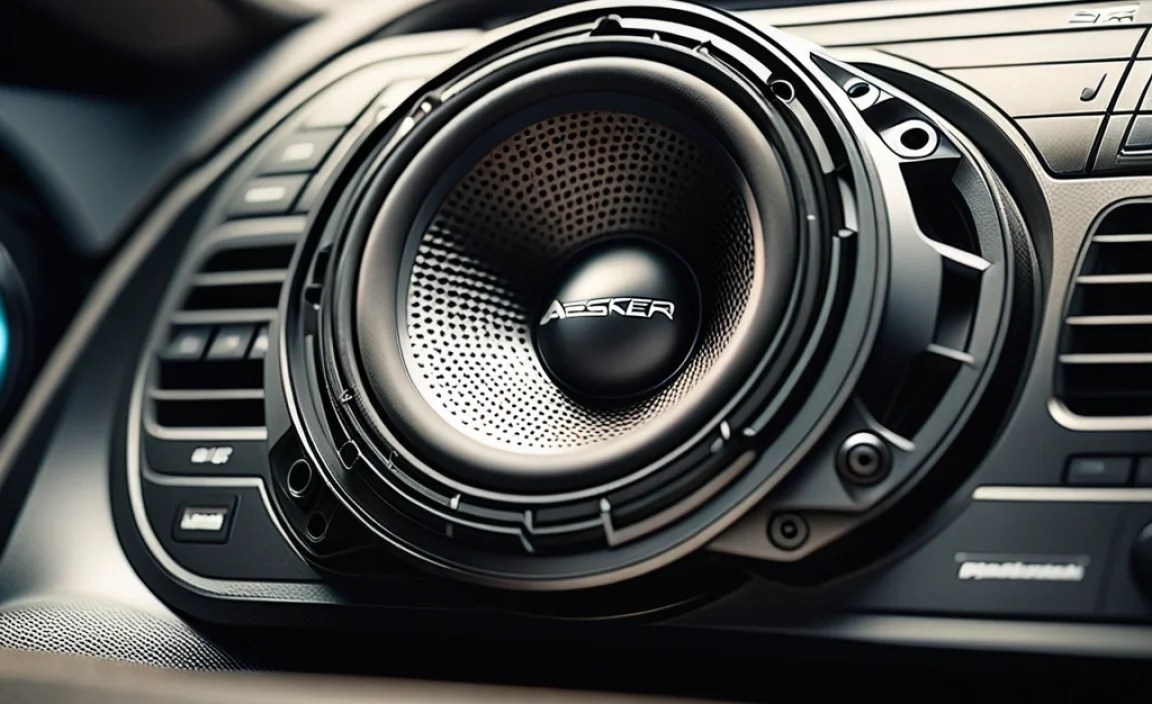
- Coaxial Speakers: These are the most common type. They have the woofer (for bass and mid-tones) and a tweeter (for high notes) mounted on the same axis, one inside the other. They are a great direct replacement for factory speakers and are relatively easy to install.
- Component Speakers: These offer superior sound quality but are more complex to install. They consist of separate components: a woofer, a tweeter, and a crossover (a device that directs frequencies to the correct speaker). The separate tweeters can be mounted higher on the door panel or dashboard for better sound staging.
Speaker Specifications to Understand (Simply Put)
You’ll see numbers and terms on speaker boxes. Here’s what’s important for a beginner:
- Power Handling (RMS & Peak):
- RMS (Root Mean Square): This is the continuous power the speaker can handle. Higher RMS usually means better performance and durability.
- Peak: This is the maximum power the speaker can handle for short bursts. RMS is the more important figure for consistent sound quality.
- Sensitivity (dB): This measures how loud a speaker can get with a given amount of power. A higher sensitivity (e.g., 90 dB or higher) means the speaker will play louder with your existing car stereo, which is great if you’re not upgrading your amplifier.
- Frequency Response (Hz): This indicates the range of sound frequencies the speaker can reproduce, from low bass (e.g., 40 Hz) to high treble (e.g., 20,000 Hz). A wider and flatter frequency response leads to more accurate and detailed sound.
- Impedance (Ohms): This measures electrical resistance. Most car speakers are 4 ohms, and most factory car stereos are designed for 4-ohm speakers. It’s best to match your speaker’s impedance to your stereo’s.
Choosing the Right Car Speakers for Your Needs
Now that you know the basics, let’s look at how to pick the best speaker for your specific situation.
1. For a Simple, Clear Audio Boost (Coaxial Speakers)
If you’re looking for the easiest and most straightforward upgrade, replacing your factory speakers with a good set of coaxial speakers is the way to go. They match the existing wiring and mounting as long as you choose the correct size.
Key Features to Look For:
- High Sensitivity (90 dB+): This ensures they’ll sound loud and clear even with your factory head unit.
- Good RMS Power Rating: Choose speakers with an RMS rating that matches or slightly exceeds your head unit’s output per channel.
- Reputable Brands: Brands like Kenwood, Pioneer, JBL, Rockford Fosgate, and Kicker offer excellent coaxial options at various price points.
2. For Higher Fidelity and More Control (Component Speakers)
If you’re aiming for a more premium sound experience and don’t mind a bit more installation effort, component speakers are worth considering. They offer better sound imaging because the tweeters can be placed closer to ear level.
Key Features to Look For:
- Separate Crossovers: These are crucial for directing sound properly.
- Quality Tweeter Material: Silk or textile dome tweeters often produce a smoother, more refined sound than cheaper plastic ones.
- Woofer Material: Polypropylene or woven composite cones are durable and offer good sound reproduction.
- Power Handling: Component systems often benefit from more power, so consider your amplifier capabilities (or plan for an upgrade).
3. Considering Your Budget
Car speaker prices can range from under $50 for a basic pair to several hundred dollars for high-end component sets. For a beginner, a good target is often between $80 and $200 for a pair of quality coaxial speakers that will deliver a noticeable improvement.
4. Matching Your Music Genre
While most good speakers handle a variety of music, some might excel in certain areas:
- Electronic Dance Music (EDM) / Hip-Hop: Look for speakers with strong bass response and good sub-bass extension.
- Rock / Metal: Drivers that reproduce mid-range punch and clear cymbal work are ideal.
- Classical / Jazz: Focus on speakers with excellent high-frequency detail and a wide, flat frequency response for accurate instrumental reproduction.
Step-by-Step: Installing Your New Car Speakers (Beginner’s Guide)
Installing new car speakers yourself can save money and is a rewarding DIY project. For this guide, we’ll focus on replacing front door coaxial speakers, which is a common and manageable task. Always consult your vehicle-specific service manual or online resources for exact panel removal procedures.
Tools You’ll Likely Need:
- New car speakers (correct size!)
- Speaker wire adapters (optional, but recommended)
- Trim panel removal tools (plastic pry tools)
- Screwdrivers (Phillips and flathead)
- Socket wrench set (for bolts)
- Wire strippers and crimpers (if not using adapters)
- Small amount of electrical tape
- An old towel or blanket (to protect your car’s interior)
The Installation Process:
- Disconnect the Battery:Safety first! To prevent electrical shorts, always disconnect the negative terminal of your car battery before starting any electrical work. Locate your battery (usually under the hood) and use a wrench to loosen the nut on the negative (-) terminal. Tuck the cable away so it can’t accidentally touch the terminal. For more information on automotive battery safety, consult resources like the National Highway Traffic Safety Administration (NHTSA).
- Remove the Door Panel:This is often the trickiest part. Look for visible screws (often behind small plastic covers or in the armrest). Gently use your trim removal tools to pry around the edges of the door panel, separating the clips. Work slowly and carefully to avoid damaging the panel or your car’s paint. Once all clips are free and screws are removed, the panel should lift up and away.
- Access the Old Speaker:With the door panel off, you’ll see the old speaker mounted in a bracket. It will be connected by wiring.
- Disconnect the Old Speaker:There’s usually a plastic connector plugged into the speaker. Press the tab and gently pull the connector off.
- Remove the Old Speaker:The speaker is typically held in place by screws. Unscrew them and carefully lift the old speaker out.
- Prepare the New Speaker:
- Using Adapters: If your new speakers don’t have plugs that match your car’s wiring, use speaker wire adapters. These plug into your car’s factory connector on one end and have bare wires or terminals on the other to connect to your new speaker.
- Stripping and Crimping: If you don’t have adapters, you might need to strip a small amount of insulation off the speaker wire ends and crimp on new terminals that fit your new speakers, or directly connect wires if your speakers have those options. Be sure to make secure connections and insulate them with electrical tape.
- Mount the New Speaker:Place your new speaker into the opening. Align the screw holes and secure it with the provided screws. You might need to use adapter plates if the new speakers have a slightly different bolt pattern.
- Connect the New Speaker:Plug in the wiring harness or connect your newly wired connections to the terminals on the new speaker. Pay attention to polarity: typically, the wire with a stripe is positive (+), and the solid-colored wire is negative (-). Connecting them backward can affect sound quality.
- Test Before Reassembly:Temporarily reconnect the battery’s negative terminal. Turn on your car and play some music. Check that the new speaker is working and sounds good. If it sounds distorted or quiet, double-check your connections and polarity. Once confirmed, disconnect the battery again.
- Reinstall the Door Panel:Carefully align the door panel and press it back into place, ensuring all clips snap in securely. Reinstall any screws you removed earlier.
- Reconnect the Battery:Reconnect the negative battery terminal and tighten it securely.
Congratulations! You’ve successfully upgraded your car’s sound.
Comparing Popular Car Speaker Brands and Models
Choosing a brand can be overwhelming. Here’s a look at some well-regarded brands and what they’re known for, helping you find a speaker that fits your preferences.
| Brand | Typical Strengths | Good For | Price Range (Approx.) |
|---|---|---|---|
| JBL | Balanced sound, durable, wide range of models. Often good sensitivity for factory systems. | All-around listening, upgrades from basic factory speakers. | $60 – $250 per pair |
| Pioneer | Clear highs, decent bass, good value for money. | Everyday listening, affordable upgrades. | $50 – $200 per pair |
| Kenwood | Solid performance, good clarity, often good power handling. | General music enjoyment, moderate volume listening. | $70 – $220 per pair |
| Rockford Fosgate (Punch/Prime Series) | Punchy bass, robust build, high efficiency (good sensitivity). | Energetic music genres, systems where bass is a priority. | $90 – $300 per pair |
| Kicker (CS/DS Series) | Strong, clear sound, good bass response, durable. | Drivers who want a full sound with impact. | $70 – $200 per pair |
| Morel (Hybrid Integra/Tempo Ultra) | Exceptional clarity, natural sound reproduction, premium audio. | Audiophiles, those seeking the finest detail and realism. | $200 – $500+ per pair (often component) |
| Alpine (Type-S/R Series) | Tuned for clarity and dynamics, reliable performance. | Balanced sound, those familiar with the Alpine brand. | $80 – $300 per pair |
Note: Prices are approximate and can vary significantly based on model, retailer, and sales. Always check current pricing and specific model reviews.
FAQ: Your Car Speaker Questions Answered
Q1: Do I need an amplifier to upgrade my car speakers?
A: Not necessarily! Many aftermarket speakers are designed to work well with factory head units, especially if they have high sensitivity. If you want to get the most out of higher-end speakers or achieve very high volumes, an external amplifier is recommended, but it’s not a requirement for a basic upgrade.
Q2: Can I mix different brands of speakers in my car?
A: Yes, you can mix brands, but aim for similar performance characteristics. For the best sound stage and imaging, it’s ideal to have the same type and quality of speakers in the front and rear. However, for a simple front-speaker upgrade, mixing is perfectly fine.
Q3: What is the difference between car speakers and home audio speakers?
A: Car speakers are built to withstand tougher environmental conditions (temperature, humidity, vibration) and are designed to work within the specific acoustics and power limitations of a vehicle. Home speakers are not designed for these conditions.
Q4: My new speakers sound worse than the old ones. What did I do wrong?
A: This can happen. Double-check your wiring for correct polarity (+/-). Ensure the speakers are securely mounted and not vibrating against anything. Also, make sure the sensitivity of the new speakers is high enough to be driven properly by your head unit. Sometimes, a speaker needs a little time to “break in” or settle, but a drastic downgrade in sound usually points to a connection or installation issue.
Q5: Can I install larger speakers than what my car originally had?
A: Sometimes, yes, with modifications. You might need adapter plates, or you may have to cut away some of the metal in the speaker opening. This can be more advanced than a beginner install. It’s often easier to stick to the factory size or use readily available adapter kits.
Q6: How long does it take to install new car speakers?
A: For a pair of coaxial speakers in common locations like front doors, an experienced person can do it in under an hour. For a beginner, expect to take 1-3 hours per door. Take your time, be methodical, and you’ll be fine!
The “Top” in Speaker for Car Music: Elevating Your Sound
When we talk about the “top” speaker for your car music, we’re referring to speakers that excel in delivering a superior audio experience that genuinely boosts your enjoyment. This means speakers that offer clear highs, well-defined mids, and impactful bass, all reproduced accurately. It also implies choosing speakers that are well-suited to your car’s specific environment – its acoustics, the power available from your stereo, and the physical space.
Achieving this “top” level doesn’t always mean the most expensive option. It means making informed choices based on your needs and understanding the fundamental principles of speaker design and installation. For many, a high-quality pair of coaxial speakers with good sensitivity, properly installed in place of factory.