
Quick Summary:
Looking for the perfect speakers in 2025? Our UHD speaker buying guide simplifies your search! We’ll help you understand sound quality, types of speakers, and key features like connectivity and room size, ensuring you find audio that truly fits your needs and budget. Get ready for an amazing listening experience!
Choosing new speakers can feel a bit overwhelming with all the options out there. From tiny bookshelf models to giant floor-standing ones, and with terms like “UHD,” “Hi-Res Audio,” and “surround sound,” it’s easy to get lost. But don’t worry! This guide is here to make the process clear and simple. We’ll walk you through exactly what you need to know to find speakers that will make your music sound incredible, your movies feel alive, and your games more immersive. Let’s dive in and find the perfect sound for your space!
Decoding Speaker Jargon: What Does “UHD” Really Mean for Audio?

You’ve probably seen “UHD” (Ultra High Definition) associated with TVs and monitors, promising sharper, more vibrant visuals. When it comes to speakers, the term “UHD” isn’t as officially standardized as it is for video. However, manufacturers often use it to imply a high level of audio fidelity, similar to how UHD enhances picture quality. This typically means speakers capable of reproducing a wide range of frequencies with exceptional clarity and detail. Think of it as “Ultra High Definition” for your ears – delivering nuances and depth you might have missed before. This often ties into concepts like:
- High-Resolution Audio (Hi-Res Audio): This refers to audio formats that can encode more sound information than standard CDs. Think of it like a much higher resolution photo – more detail, richer color. Speakers designed for Hi-Res Audio are built to reproduce these intricate details accurately
- Wide Frequency Response: Speakers need to reproduce sounds from the deepest bass (low frequencies) to the highest treble (high frequencies). “UHD” speakers aim to cover a broader spectrum of these frequencies more faithfully.
- Dynamic Range: This is the difference between the quietest and loudest sounds a speaker can reproduce. UHD speakers often excel at handling these shifts, making quiet moments more subtle and loud moments more impactful without distortion.
Basically, when you see “UHD” on speakers, it’s a signal that the manufacturer is aiming for premium sound quality. It’s about experiencing audio that’s closer to the original recording, with more realism and impact.
Understanding Different Types of Speakers
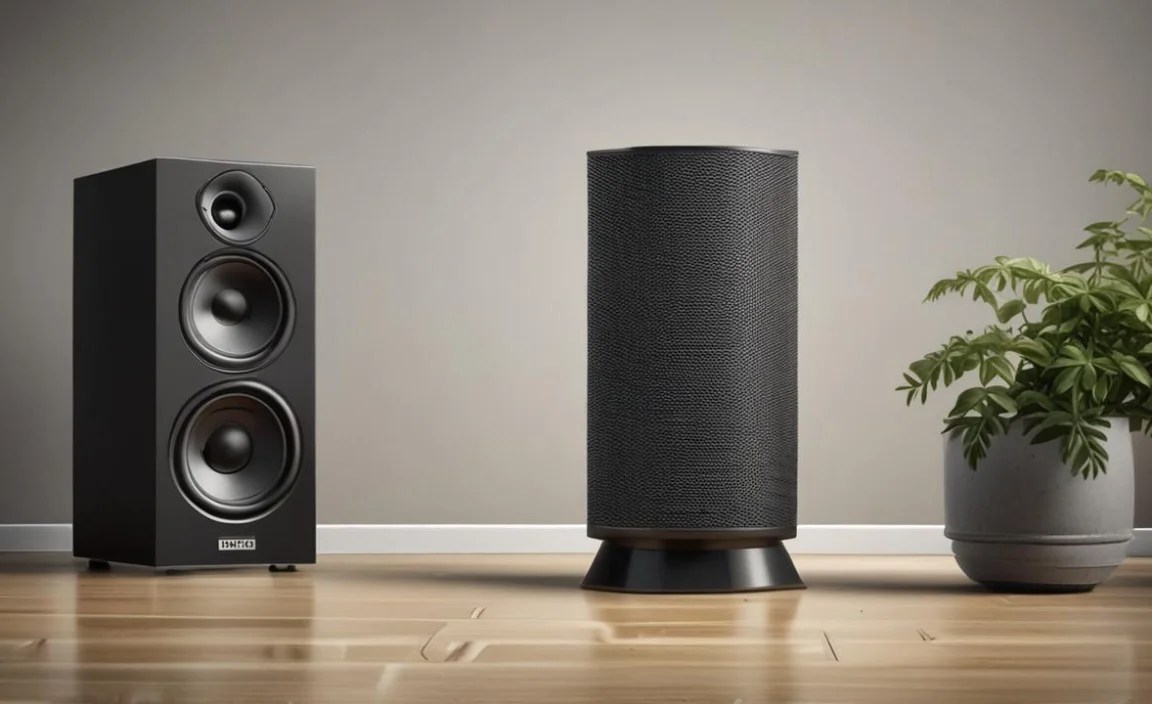
The “best” speaker isn’t a one-size-fits-all answer. The type of speaker that’s right for you really depends on what you want to use it for and where you plan to put it. Here’s a breakdown of the most common kinds:
Bookshelf Speakers
These are compact speakers named for their ability to fit on shelves or stands. They are incredibly versatile and a fantastic entry point into better audio. Bookshelf speakers offer a significant upgrade from built-in TV speakers. They are great for smaller to medium-sized rooms, providing clear mids and highs, and surprisingly good bass for their size.
- Pros: Compact, affordable, versatile, easy to set up, good sound quality for their size.
- Cons: Bass might be limited for very large rooms or those who want deep, rumbling lows.
- Best for: Stereo listening (music), secondary audio systems, smaller living rooms, bedrooms.
Floorstanding (Tower) Speakers
These are the larger, more imposing speakers that stand on their own directly on the floor. Because they are larger, they typically house bigger drivers (the parts that produce sound) and larger enclosures, allowing them to produce a more powerful and fuller sound, especially in the bass frequencies. They are ideal for larger rooms and for those who want a truly immersive experience without needing a separate subwoofer.
- Pros: Powerful sound, deep bass, fill larger rooms effectively, often aesthetically pleasing.
- Cons: Expensive, require significant room space, can overpower smaller rooms.
- Best for: Main home theater systems, large living rooms, dedicated listening rooms, serious music lovers.
Soundbars
Soundbars are long, slender speaker systems designed to sit horizontally, typically in front of or below a TV. They are a very popular choice for their simplicity and ability to dramatically improve TV audio without the clutter of multiple speakers. Many soundbars are bundled with a wireless subwoofer for better bass.
- Pros: Space-saving, easy setup (often one cable), significant audio upgrade over TV speakers, sleek look.
- Cons: Soundstage can be less immersive than separate speakers, sound quality varies greatly by price.
- Cons: Soundstage can be less immersive than separate speakers, sound quality varies greatly by price.
- Best for: Improving TV sound without complex setups, apartments, bedrooms, living rooms where space is a premium.
Satellite Speakers (Part of Surround Sound Systems)
These are small, compact speakers usually found as part of home theater-in-a-box systems or sold in sets to build your own surround sound. They are designed to handle mid-range and high frequencies, with a separate subwoofer typically handling the low bass. When placed around a room, they create an immersive, 360-degree sound experience.
- Pros: Create immersive surround sound, discreet placement options.
- Cons: Rely heavily on a subwoofer for bass, full system can be complex to set up, sound quality can be basic in cheaper systems.
- Best for: Home theater enthusiasts wanting to feel “in the action” of movies and games.
Subwoofers
The subwoofer is a speaker dedicated solely to reproducing low-frequency sounds – the rumbling bass notes and deep impacts in music and movies. You can buy them as standalone units to complement existing speaker systems or they often come bundled with soundbars or satellite speaker systems.
- Pros: Adds significant depth and impact to the sound, makes movies and music more thrilling.
- Cons: Can be large and bulky, require proper placement to avoid boomy bass, can be expensive.
- Best for: Anyone wanting to feel the rumble; essential for home theater and immersive gaming.
—
Speaker Configurations: Stereo, 2.1, 5.1, and Beyond
When you start looking at systems, you’ll see numbers like 2.1, 5.1, or even 7.1. These refer to the number of speakers and how they’re set up:
- Stereo (2.0): This is the most basic setup, using two speakers placed apart. Essential for music listening, it creates a soundstage where instruments and vocals can be heard in different positions between the speakers.
- 2.1 System: This adds a subwoofer (“.1”) to a stereo setup. You get your two main speakers plus dedicated bass, making music and movies sound fuller.
- 5.1 Surround Sound: This is a common home theater setup using six channels: three in front (left, center, right), two surround speakers (side or rear), and one subwoofer. It creates an immersive sound field, making you feel surrounded by the audio.
- 7.1 Surround Sound: This expands on 5.1 by adding two more rear surround speakers, offering even more precise directional audio and a wider soundstage.
For our “UHD” or high-fidelity experience, focusing on the quality of these individual components is key, regardless of configuration.
Key Features to Look For in 2025 Speakers

Beyond the type and configuration, several technical aspects will significantly impact your listening experience. Here’s what to focus on:
Connectivity: How Will You Hook Them Up?
How your speakers connect to your devices is crucial for convenience and compatibility. In 2025, you’ll find a mix of traditional and modern options:
- Wired Connections:
- RCA/Analog: The classic red and white (or black) connectors. Still common for connecting to older receivers or some audio equipment.
- 3.5mm Aux Input: A headphone-jack-style input found on many smaller speakers and soundbars for simple plug-and-play with computers, phones, or portable devices.
- Optical/Digital Coaxial: These more advanced wired connections transmit digital audio signals, often offering cleaner sound and higher quality than analog. Essential for connecting to modern TVs and sound systems.
- HDMI ARC/eARC: This is the gold standard for TV audio. HDMI ARC (Audio Return Channel) lets your TV send audio back to a soundbar or receiver over the HDMI cable that might also be sending video. eARC is an enhanced version with higher bandwidth, supporting uncompressed audio formats for even better quality. Very important if “UHD” audio is a priority.
- Wireless Connections:
- Bluetooth: Ubiquitous for connecting smartphones, tablets, and computers wirelessly. Look for newer Bluetooth versions (like 5.0 or higher) for better range, stability, and audio quality (e.g., aptX codecs can improve Bluetooth sound).
- Wi-Fi/Network Streaming: Allows speakers to connect to your home network, enabling direct streaming from services like Spotify, Apple Music, or Tidal without needing your phone. This often supports higher-resolution audio formats and multi-room audio capabilities.
- Proprietary Wireless: Some home theater systems use their own wireless technology, often for rear speakers, ensuring a dedicated, low-latency connection.
Tip: When aiming for “UHD” audio, HDMI eARC and high-quality Wi-Fi streaming are generally your best bets for preserving the most detail.
Power (Wattage): Does Bigger Always Mean Better?
Wattage indicates how much power the speaker can handle or output. While a higher wattage can mean louder sound, it’s not the sole indicator of quality. A higher wattage speaker might play louder without distortion, which is beneficial for larger rooms or for those who like to crank up the volume. However, poor-quality high-wattage speakers can sound harsh. Focus on wattage in conjunction with sensitivity (see below) and the size of your room.
- Small Rooms (e.g., bedroom, office): 20-50 watts per channel might be sufficient.
- Medium Rooms (e.g., living room): 50-100 watts per channel is a good range.
- Large Rooms (e.g., open-plan living, home theater): 100+ watts per channel is recommended for sufficient headroom.
Sensitivity: How Loud Can They Get with Less Power?
Sensitivity, measured in decibels (dB), tells you how loud a speaker will play at a specific distance (usually 1 meter) when given 1 watt of power. A higher sensitivity rating means the speaker is more efficient and will play louder with less amplifier power. This is particularly important if you’re using a receiver or amplifier that isn’t very powerful.
- High Sensitivity (90 dB and above): These speakers are very efficient and can be driven by less powerful amplifiers, making them a great choice for pairing with standard AV receivers or even some high-fidelity amplifiers.
- Low Sensitivity (below 90 dB): These speakers require more power from the amplifier to reach the same volume. They might sound great, but you’ll need a beefier amp to drive them properly.
Frequency Response: Capturing the Full Range of Sound
This is stated as a range (e.g., 40 Hz – 20 kHz). The first number (Hz, Hertz) indicates the lowest bass frequency the speaker can reproduce, and the second number (kHz, Kilohertz) indicates the highest treble frequency. A wider range generally means more detail and a more complete sound.
- For “UHD” Audio: Aim for a broad frequency response. For example, a response that goes down to 30 Hz or even 20 Hz is excellent for deep bass. A response extending to 20 kHz or higher is standard, but the accuracy within that range is what matters most for clarity.
- Consider your needs: If you listen to a lot of electronic music or watch action movies, a lower Hz number (better bass) is crucial. If you primarily listen to vocals and acoustic music, the mid-range and treble accuracy might be your priority.
External Link: Learn more about audio frequencies and their impact on sound perception from the Audio Consultants Learning Center. (Note: This is a reputable industry resource.)
Driver Size and Type: The Heart of the Speaker
Speakers use different drivers to produce different frequencies: woofers for bass, mid-range drivers for vocals and instruments, and tweeters for high frequencies (treble). The size and material of these drivers impact sound quality.
- Woofers: Usually range from 4 inches to 15 inches or more. Larger woofers can move more air, producing deeper and more powerful bass.
- Mid-Range Drivers: Typically 3 to 6 inches. These are critical for the clarity of vocals and most instruments.
- Tweeters: Usually 1 inch or less. They can be dome (soft or hard), ribbon, or horn types. Dome tweeters are common, with materials like silk or fabric often praised for a smoother sound, while metal or ceramic can offer more sparkle.
What to look for: High-quality drivers in a correctly designed enclosure are key to that “UHD” clarity. Don’t just look at size; consider the materials and the manufacturer’s reputation.
Impedance: Matching Your Amp to Your Speakers
Impedance, measured in ohms (Ω), is the electrical resistance the speaker presents to the amplifier. Most home speakers are rated between 4 and 8 ohms. It’s important to ensure your amplifier or AV receiver can handle the impedance of your speakers. Most modern amps are designed to work with both 4 and 8-ohm speakers, but it’s always best to check your equipment’s manual.
- Generally, lower impedance speakers draw more power from the amplifier. If your amp is rated for 8 ohms, try to stick with 8-ohm speakers or higher. If it’s rated for 4 ohms, you have more flexibility.
- Conflicting Impedance: Mismatching can lead to the amplifier overheating or producing distorted sound. Consult your AV receiver manual if unsure.
Room Acoustics: Making Your Space Sound Its Best

Even the most expensive “UHD” speakers won’t sound their best if your room works against them. Room acoustics play a huge role. Here’s how to improve it:
Speaker Placement is Key
Proper placement can make a dramatic difference. For stereo listening, speakers should ideally form an equilateral triangle with your ideal listening position.
- Distance from Walls: Keep speakers a few feet away from the back and side walls. This reduces “room gain” and muddy bass.
- Toe-in: Angle speakers slightly inward towards your listening position.
- Tweeter Height: Aim to have the tweeters at ear level when you’re seated.
Dealing with Reflections and Echoes
Hard surfaces (bare walls, glass tables, hardwood floors) reflect sound, causing echoes and muddiness. Soft, sound-absorbing materials help tame these reflections.
- Soft Furnishings: Rugs, curtains, sofas, and upholstered chairs absorb sound.
- Acoustic Treatments: For audiophiles, specialized acoustic panels or bass traps can significantly improve sound clarity, especially in dedicated listening rooms. You can find DIY guides for these online.
- Bookcases and Shelving: A well-stocked bookshelf can act as a natural sound diffuser, breaking up sound waves.
External Link: The Rtings.com guide offers practical advice on speaker placement for optimal sound.
Budgeting for Your “UHD” Speakers
The term “UHD” can sometimes come with a premium price tag, but amazing sound quality is achievable at various price points. Consider your budget carefully, and remember to factor in potential accessories.
Price Tiers to Consider
speakers can range from under $100 to tens of thousands of dollars. Here’s a general idea:
- Budget-Friendly ($100 – $300): Excellent entry-level bookshelf speakers or decent soundbars that offer a clear upgrade from TV speakers.
- Mid-Range ($300 – $800): High-quality bookshelf speakers, capable soundbars with subwoofers, or entry-level floorstanding speakers begin to appear here, often offering better materials and sound refinement.