
Quick Summary: A TV resolution comparison chart helps you match your TV’s pixel count (like 4K or 1080p) with the optimal viewing distance and a suitable wall mount. This guide simplifies choosing the right mount by explaining resolutions and how they affect what you see on screen.
Choosing the right wall mount for your TV can feel a bit confusing, especially when you start hearing terms like 4K, 8K, and Full HD. Does your TV’s resolution actually matter when picking a mount? Absolutely! The number of pixels on your screen directly impacts how close you can sit and what kind of picture you’ll enjoy. This guide is here to clear up all those questions about TV resolution and how it relates to finding the perfect wall mount. We’ll break down what resolution means in simple terms and show you how to find the best spot for your TV, no guesswork involved. Get ready to enjoy your TV like never before!
Understanding TV Resolution for Wall Mounting
When we talk about TV resolution, we’re really talking about the number of tiny dots, called pixels, that make up the picture on your screen. More pixels mean a sharper, clearer, and more detailed image. Think of it like looking at a mosaic – the more tiles you have, the more intricate and lifelike the picture becomes. Different resolutions offer different levels of detail and look best from certain distances. Knowing your TV’s resolution is the first step to understanding how far away you should sit and, crucially, how a wall mount can enhance your viewing experience.
What Do TV Resolutions Mean?
Let’s demystify those common resolution numbers:
- HD (High Definition) / 720p: This was the standard for a while. It has 1280 pixels horizontally and 720 pixels vertically. It’s good, but you’ll notice it’s not as sharp as newer technologies.
- Full HD (FHD) / 1080p: This is a big step up with 1920 pixels horizontally and 1080 pixels vertically. It offers a much clearer picture and has been the most common for many years.
- 4K UHD (Ultra High Definition): This is the current king, boasting 3840 pixels horizontally and 2160 pixels vertically. That’s four times the pixels of Full HD! Images are incredibly sharp and detailed.
- 8K UHD: The latest and greatest, with 7680 pixels horizontally and 4320 pixels vertically. That’s sixteen times the pixels of Full HD! While stunning, it’s still very new, and not much content is available in 8K yet.
Why Resolution Matters for Viewing Distance
The resolution of your TV directly affects how close you can comfortably sit without seeing individual pixels. If you sit too close to a lower-resolution TV, the image might look blurry or “pixelated.” Sit the right distance from a higher-resolution TV, and you get an incredibly immersive experience where the image seems to vanish, leaving just the picture.
A good rule of thumb:
- For 1080p (Full HD): Sit about 1.5 to 2.5 times the screen’s diagonal size away.
- For 4K UHD: You can sit much closer, about 1 to 1.5 times the screen’s diagonal size away. This makes for a more cinematic feel.
- For 8K UHD: You can get even closer, as the pixels are so tiny they’re virtually invisible even at very short distances.
This is where wall mounting comes in. It allows you to achieve that optimal viewing distance, whether you want a cozy living room setup or a home theater experience.
TV Resolution Comparison Chart & Viewing Distance Guide
To help you visualize, here’s a comparison chart. Remember, these are general guidelines, and personal preference plays a role!
| TV Resolution | Pixel Count (Horizontal x Vertical) | Recommended Viewing Distance (for a 55-inch TV) | Best for |
|---|---|---|---|
| HD (720p) | 1280 x 720 | Approximately 7 to 11 feet | Smaller TVs, secondary rooms, budget-conscious setups |
| Full HD (1080p) | 1920 x 1080 | Approximately 5 to 8 feet | Most common for living rooms, gaming, general TV watching |
| 4K UHD | 3840 x 2160 | Approximately 3 to 5 feet | Larger screens, immersive gaming, cinematic viewing |
| 8K UHD | 7680 x 4320 | Approximately 2 to 3 feet | Very large screens, future-proofing, ultra-detailed content (when available) |
Example: If you have a 65-inch 4K TV, sitting 3 to 5 feet away will give you an incredible, detailed picture. A wall mount can help you place your TV at this perfect distance from your couch.
Choosing the Right Wall Mount Based on Resolution
While the resolution doesn’t directly change the type of wall mount you need (e.g., a fixed, tilting, or full-motion mount), it influences the placement and the overall viewing experience that the mount enables. The key consideration is ensuring your mount allows you to position the TV at the optimal distance from your seats, which is determined by its resolution.
Mount Types Explained
Most wall mounts fall into a few main categories:
- Fixed Mounts: These hold your TV flat against the wall, like a picture frame. They are simple, low-profile, and usually the most affordable. They are great if your TV is already at eye level and you don’t need to adjust the angle.
- Tilting Mounts: These allow you to tilt your TV up or down. This is helpful if you need to mount your TV higher than eye level (common in bedrooms or over fireplaces) to reduce glare or improve viewing angles.
- Full-Motion (Swivel) Mounts: These offer the most flexibility, allowing you to tilt, swivel, and extend the TV away from the wall. They are perfect for rooms with multiple seating areas or if you want to angle the TV towards different parts of the room.
Matching Mount Placement to Resolution and Room
Here’s how to think about placement:
- For 4K and 8K TVs: Because you can sit closer, a full-motion mount can be excellent for truly immersing yourself. You can pull the TV slightly out and angle it for a more cinematic feel. Fixed or tilting mounts are fine if your seating is already at the ideal distance.
- For 1080p TVs: Since you’ll be sitting a bit further away, a fixed or tilting mount is usually sufficient. You want the TV centered in your field of vision from your typical viewing spot.
- Room Layout: Consider where your windows and lights are. A tilting mount can help combat glare if your TV faces a window. If your couch isn’t directly in front of the TV, a full-motion mount is essential for angling the screen.
Important Mount Feature: VESA Compatibility
Regardless of resolution, the most critical factor for compatibility is the VESA mounting pattern on the back of your TV. Most TVs and mounts use standardized VESA patterns (e.g., VESA 200x200mm, VESA 400x400mm). Your mount MUST match your TV’s VESA pattern. You can find this information in your TV’s manual or by measuring the screw hole pattern on the back of your TV.
To learn more about VESA standards and how to find yours, check out resources on display mounting standards. For example, the VESA Mount Standard outlines these specifications.
Step-by-Step Guide: Mounting Your TV
Mounting a TV, especially with the goal of optimizing for its resolution, is a project you can tackle with a little patience. Always ensure your wall can support the weight of your TV and the mount. Mounting into studs is highly recommended for safety.
Step 1: Gather Your Tools and Materials
Before you begin, make sure you have everything:
- Your chosen TV wall mount (ensure it’s compatible with your TV’s size, weight, and VESA pattern)
- Your TV
- A stud finder (essential for mounting to wall studs)
- A level
- A drill with appropriate drill bits
- A screwdriver set (Phillips and flathead)
- A tape measure
- Pencils
- A socket wrench set (often needed for lag bolts)
- The wall mount’s instruction manual
- Optional: A helper (highly recommended for safety and ease)
Step 2: Determine the Ideal TV Height and Location
This is where resolution plays a key role. Think about your typical viewing position. The center of the screen should ideally be at or slightly below eye level when you are seated. For 4K and 8K TVs, you have more flexibility to mount them slightly lower to take advantage of the close-up, immersive viewing.
Calculation Tip: Measure the height from your seated eye level to the floor. Then, measure the height of your TV. Subtract the TV height from your eye-level measurement. Divide the result by 2 to find the distance from the bottom of the TV to the desired horizontal center line. Mark this center point on the wall.
Step 3: Locate Wall Studs
This is CRITICAL for a secure mount. Electrical stud finders are readily available and easy to use. Run the stud finder horizontally across where you plan to mount the TV until it indicates a stud. Mark the edges of the stud. Repeat to find at least one, preferably two, studs for your mount’s bracket.
For more information on finding studs, check out home improvement guides like those from This Old House.
Step 4: Mount the Wall Bracket
Hold the wall bracket against the wall, aligning it with your marked stud locations and using your level to ensure it’s perfectly horizontal. Mark the screw hole locations on the wall. Drill pilot holes through your marks. Then, attach the wall bracket to the studs using the lag bolts provided with your mount. Make sure it’s snug and secure!
Step 5: Attach the TV Brackets
Lay your TV screen-down on a soft, clean surface (like a blanket). Locate the VESA screw holes on the back of your TV. Attach the vertical brackets from your wall mount to the TV using the screws provided. Ensure the brackets are oriented correctly according to the mount’s instructions.
Step 6: Hang the TV on the Mount
With your helper, carefully lift the TV and align the brackets attached to the TV with the corresponding hooks or arms on the wall bracket. Most mounts have a way to secure the TV once it’s in place, often with locking screws or clips. Double-check that the TV is securely latched.
Step 7: Connect Cables and Final Adjustments
Connect all your HDMI cables, power cords, and other peripherals. Use cable management solutions to keep things tidy. If you have a tilting or full-motion mount, test its range of motion and adjust the viewing angle as needed to achieve the perfect picture based on your TV’s resolution and seating position.
Tips for Optimizing Your Viewing Experience with a Wall Mount
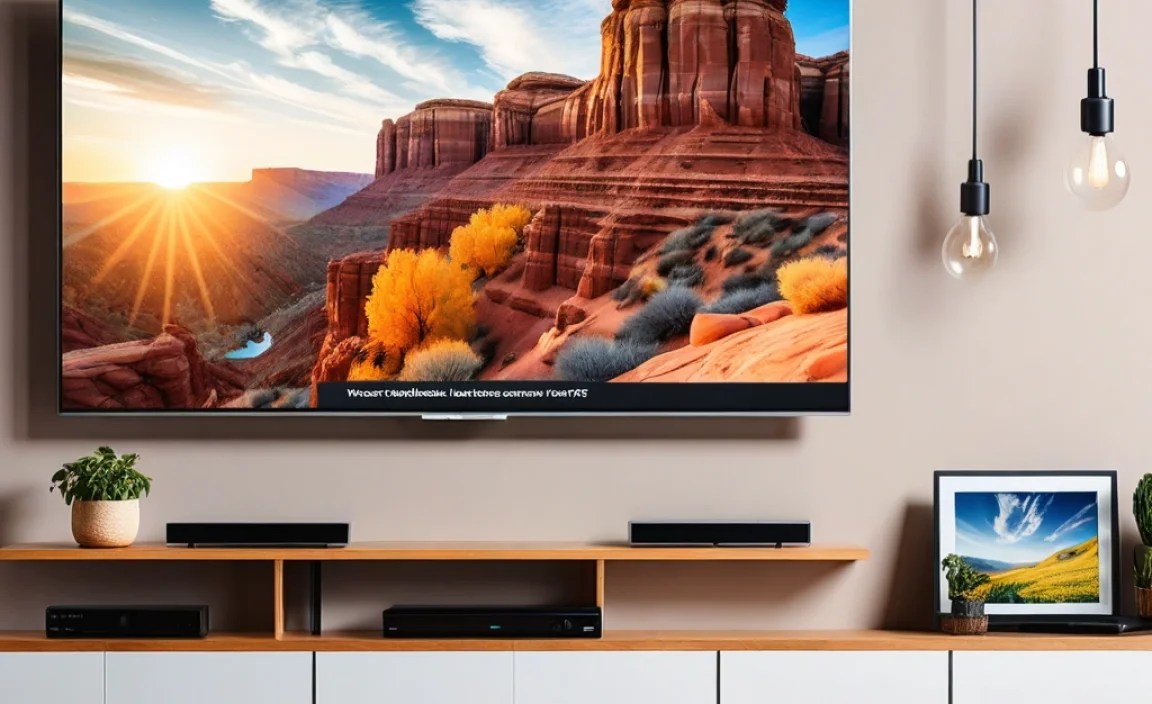
Once your TV is mounted, consider these tips to get the most out of it, especially when considering its resolution for immersive viewing:
- Reduce Glare: Position your TV to avoid direct light from windows or overhead lamps. Tilting mounts are great for this.
- Cable Management: Use cord covers, sleeves, or in-wall routing to hide cables for a clean, professional look.
- Soundbar Placement: If you have a soundbar, ensure it doesn’t block the bottom of the screen, or consider a mount that can accommodate it.
- Adjust for Different Seating: Full-motion mounts are ideal if you have multiple viewing areas or like to adjust your TV’s angle for different activities (e.g., gaming vs. movie watching).
- Calibrate Your Picture: Many modern TVs have picture settings that can be fine-tuned. Researching the best settings for your specific TV model can enhance the detail visible due to its resolution.
Frequently Asked Questions (FAQ)
Q1: Do I need a special wall mount for a 4K TV?
No, not specifically for the resolution itself. You need a mount that is compatible with your TV’s size, weight, and VESA pattern. However, the benefit of 4K resolution means you can sit closer, so a mount that allows for optimal positioning (like a full-motion mount) can enhance the experience.
Q2: How do I know which VESA size my TV has?
You can usually find the VESA pattern in your TV’s manual or on the manufacturer’s website. Alternatively, measure the distance between the screw holes on the back of your TV (e.g., 200mm horizontally x 200mm vertically is VESA 200×200).
Q3: Can I mount a TV on a drywall/plaster wall without finding studs?
It is strongly discouraged. Drywall is not strong enough to securely hold the weight of a TV and mount. Always mount to wall studs or use heavy-duty anchors specifically rated for the weight, installed into solid framing. For guidance on wall anchors, consult resources from general construction safety.
Q4: How high should I mount my TV?
The general rule is to have the center of the screen at or slightly below eye level when you are seated in your primary viewing position. This height can vary based on furniture and personal preference. For 4K/8K TVs, you might mount it a bit lower to get closer to the screen.
Q5: What’s the difference between a tilting and a full-motion wall mount?
A tilting mount only allows you to adjust the TV’s vertical angle (up/down). A full-motion mount offers more versatility, allowing you to tilt, swivel, extend, and sometimes even rotate the TV, giving you greater flexibility in positioning.
Q6: Does the weight of my TV affect the wall mount choice?
Absolutely. Every wall mount has a maximum weight capacity. You must choose a mount that can safely support your TV’s weight. Always check the specifications carefully.
Conclusion
Understanding TV resolution is more than just knowing the buzzwords; it’s about optimizing your viewing experience. By matching your TV’s resolution to the ideal viewing distance and selecting a wall mount that allows for precise placement, you unlock the full potential of your home entertainment system. Whether you’re enjoying the incredible detail of 4K or the crispness of Full HD, the right mount ensures you get the best picture and comfort. With this guide, you’re well-equipped to choose a mount that complements your TV’s resolution and transforms your living space into a personal cinema. Happy mounting, and enjoy those beautiful pixels!