
Quick Summary: Back of your TV holds the key to better entertainment! Understanding TV ports like HDMI, USB, and Optical helps you connect devices like game consoles and soundbars easily. Knowing these simple connections unlocks smarter control and enhances your viewing experience, turning a confusing rear panel into your remote control’s best friend.
Ever stare at the back of your TV, wondering what all those little openings are for? You’re not alone! It can feel like a mystery designed to keep us away from our favorite shows. But what if I told you that understanding these “TV ports” is actually super simple and can unlock some seriously cool secrets for your remote control and overall entertainment setup? Get ready to transform that confusing panel into your command center. We’ll break down each port, what it does, and how it makes your remote control experience even better, leading to a more immersive and connected home theater.
Why Knowing Your TV Ports is a Game-Changer

Think of your TV’s ports as the doors and windows that let information and commands in and out. They’re how your TV talks to everything else – your Blu-ray player, your game console, your streaming stick, even your soundbar. When you understand these ports, you can:
- Connect devices correctly for the best picture and sound quality.
- Troubleshoot connection issues faster than ever.
- Unlock advanced features that make your remote control smarter.
- Make sure you’re getting the most out of your entertainment gear.
It’s not about complex electronics; it’s about simple connections that make a big difference. Let’s demystify the back of your TV and see how it all works together!
The Most Common TV Ports Explained
Most modern TVs have a few key ports that are essential for connecting your gadgets. Let’s take a look at the usual suspects:
HDMI (High-Definition Multimedia Interface)
This is the superstar of TV ports today. HDMI is your go-to for sending both high-definition video and digital audio from one device to your TV. It carries a clean, crisp signal, meaning you get the best possible picture and sound without fuss.
- What it looks like: A flat, trapezoidal shape, usually wider than it is tall.
- What it’s for: Connecting Blu-ray players, gaming consoles (PlayStation, Xbox), streaming devices (Roku, Apple TV), cable boxes, and soundbars.
- Why it’s great: One cable handles both video and audio, simplifying your setup. Newer HDMI versions also support higher resolutions (like 4K and 8K), faster refresh rates for smoother motion, and advanced features like HDR (High Dynamic Range) for better color and contrast.
- Remote Control Secret: HDMI-CEC (Consumer Electronics Control) is a feature that lets your remote control multiple devices. For example, when you turn on your streaming device, HDMI-CEC can tell your TV to switch to the correct input and even turn on your soundbar. You might see it labeled as Anynet+ (Samsung), Bravia Sync (Sony), or Simplink (LG). Check your TV and device settings to enable it!
USB (Universal Serial Bus)
You probably know USB from your computer, but it’s also a handy port on your TV. USB ports are versatile and can be used for a few different things.
- What it looks like: A rectangular slot. There are different types, but on TVs, you’ll most commonly see USB-A.
- What it’s for:
- Playing media: Load photos, videos, or music onto a USB drive and plug it into your TV to play them directly.
- Powering devices: Some streaming sticks or small devices can be powered by a USB port, freeing up a power outlet.
- Firmware updates: Technicians might use USB ports for software updates.
- Connecting accessories: Occasionally, you might connect a webcam or other accessories, though this is less common for standard TVs.
- Remote Control Secret: While not directly controllable by your remote, a USB drive filled with photos or videos means you can access them quickly without needing another device. Point your remote, select the USB input, and browse!
Ethernet (LAN)
If your TV is “smart” and connects to the internet, you’ll likely find an Ethernet port. It’s a wired connection to your home network.
- What it looks like: A slightly larger, keystone-shaped port.
- What it’s for: Providing a stable internet connection for your TV’s smart features, like streaming apps (Netflix, Hulu, YouTube) and online updates.
- Why it’s great: A wired connection is generally faster and more reliable than Wi-Fi, which is perfect for uninterrupted streaming and downloads.
- Remote Control Secret: A stable internet connection means your TV’s smart hub responds snappily to your remote. No more lag when you’re trying to open an app or navigate menus!
Optical Audio (Toslink)
This port is all about delivering high-quality digital audio. It uses a light beam to transmit sound, offering a clean signal to your audio system.
- What it looks like: A small, often square-ish port with a flap. You might need to remove a small plastic cap from the cable and the port.
- What it’s for: Connecting your TV to a soundbar, AV receiver, or home theater system to get the best possible audio output from your TV.
- Why it’s great: It supports digital surround sound formats like Dolby Digital and DTS, giving you a more immersive audio experience than basic TV speakers. It’s a step up from analog RCA cables.
- Remote Control Secret: By connecting your soundbar or receiver via optical, you can often use HDMI-CEC (if your receiver supports it and is connected via HDMI to your TV) or a universal remote to control the volume of your external audio system with your TV remote. This means one less remote to juggle!
Audio Out (Headphone Jack / RCA)
Many TVs, especially older ones, have analog audio outputs. These are typically a 3.5mm headphone jack or a pair of red and white RCA jacks.
- What it looks like:
- Headphone Jack: A small, circular port, similar to what you’d use for headphones on your phone.
- RCA: Two circular ports, one red (right channel) and one white (left channel).
- What it’s for: Sending audio from your TV to external speakers, older sound systems, or headphones.
- Why it’s useful: If you have older audio equipment or want to plug in headphones for private listening, these ports are indispensable.
- Remote Control Secret: Plugging headphones directly into the TV often automatically silences the TV’s built-in speakers. This is a quick way to get private listening without needing to mess with audio settings on a separate system.
Less Common, But Still Useful!
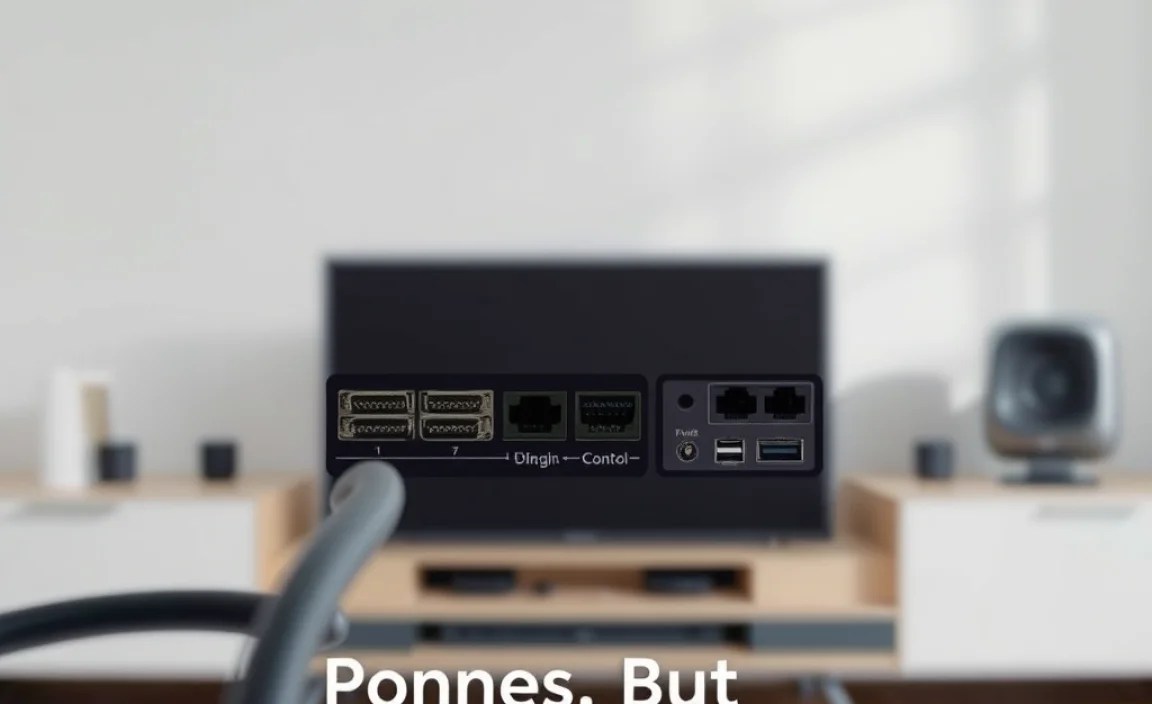
You might encounter a few other ports on your TV, depending on its age and model. Knowing what they are can save you a headache!
Component Video & Composite Video
These are older analog video connection types, usually found on older TVs or those that need to support older devices.
- What it looks like:
- Component: Three color-coded RCA jacks: green (Y), blue (Pb), and red (Pr) for video, often paired with red and white for audio.
- Composite: A single yellow RCA jack for video, usually paired with red and white for audio.
- What it’s for: Connecting older VCRs, DVD players, game consoles (like PS2, original Xbox), or camcorders that don’t have HDMI outputs.
- Why it’s still relevant: If you’ve got a cherished collection of VHS tapes or an old game console you love, these ports are your link to the past.
- Remote Control Secret: Using these ports simply involves selecting the right input on your TV remote (often labeled AV, Video 1, Component, etc.). While the picture quality won’t match HDMI, it gets your old gear playing!
VGA (Video Graphics Array)
You’ll typically find VGA ports on older TVs and computer monitors.
- What it looks like: A trapezoidal port with 15 pins, usually blue.
- What it’s for: Connecting a computer or laptop to your TV to use the TV as a monitor.
- Why it’s useful: Great for presentations or using your TV for a larger computer screen experience.
- Remote Control Secret: Once connected, you’ll use your TV remote to select the VGA input. However, for laptops, you’ll usually need to adjust display settings on the computer itself to get the image to appear correctly.
A Table to Help You Connect
To make things even clearer, here’s a quick reference table summarizing the most common ports and their primary uses. Think of this as your quick-guide cheat sheet!
| Port Name | Primary Use | Video Quality | Audio Quality | Common Connections | Remote Control Enhancement |
|---|---|---|---|---|---|
| HDMI | All-in-one digital connection for video and audio | Excellent (up to 8K, HDR) | Excellent (digital surround sound) | Blu-ray, game consoles, streamers, soundbars | HDMI-CEC for controlling multiple devices with one remote |
| USB | Media playback, powering devices, updates | N/A (plays files) | N/A (plays files) | USB flash drives, external hard drives | Quick access to media files via remote browsing |
| Ethernet (LAN) | Wired internet connection | N/A (for internet) | N/A (for internet) | Router | Stable smart TV features and responsive remote navigation |
| Optical Audio | Digital audio out | N/A (audio only) | Excellent (digital surround sound) | Soundbars, AV receivers | Can work with HDMI-CEC for volume control |
| Audio Out (3.5mm/RCA) | Analog audio out | N/A (audio only) | Good (stereo) | Headphones, older stereos | Automatic headphone mode |
| Component Video | Analog video out | Good (HD) | Analog (separate cables) | Older game consoles, DVD players | Selectable input via remote |
| Composite Video | Analog video out | Fair (SD) | Analog (separate cables) | VCRs, older camcorders | Selectable input via remote |
Unlocking Remote Control Gadgets with Ports

Now that you know the ports, let’s dive into those remote control secrets. Many of these are enabled by the ports you’ve just learned about.
HDMI-CEC: The Remote’s Best Friend
I mentioned HDMI-CEC earlier, and it’s truly one of hidden gems. This feature allows devices connected via HDMI to communicate with each other. Imagine this:
- You power on your streaming device, and your TV automatically switches to the correct HDMI input.
- You press the power button on your TV remote, and all connected CEC-enabled devices (like your soundbar and Blu-ray player) turn off too.
- You use your TV remote’s directional buttons to navigate the menus of your connected streaming device.
To activate HDMI-CEC, you usually need to enable it in your TV’s settings menu (look for names like Anynet+, Bravia Sync, Simplink, Viera Link, etc.) and on your connected device. It’s the closest thing we have to a universal remote for simple tasks right out of the box.
Soundbar Integration
Connecting a soundbar via HDMI ARC (Audio Return Channel – a special feature of HDMI ports, usually labeled) or Optical Audio is key. HDMI ARC allows audio to travel back from the TV to the soundbar using the same HDMI cable that sends video to the TV. This is incredibly convenient.
- Remote Control Power: With HDMI ARC and CEC enabled, you can often control your soundbar’s volume using your TV remote. No more grabbing two remotes to adjust sound!
- Simplified Audio: The TV sends audio from all its sources (built-in apps, other connected HDMI devices that are routed through the TV) to the soundbar.
Check the labels on your HDMI ports. One of them might be specifically marked “ARC.” If you’re using an optical cable, you might still be able to control volume via your TV remote if your soundbar supports it and is configured correctly. This is why port knowledge is power!
Smart TV Navigation
Your smart TV is designed to be navigated with its remote. The Ethernet port (or a stable Wi-Fi connection) ensures a quick response from your remote’s button presses. When the internet is strong:
- Apps load faster.
- Menus are responsive.
- Search functions work without frustrating delays.
This directly impacts your remote control experience. A laggy smart TV can feel broken, but often, it’s just a matter of a weak internet signal, which an Ethernet cable can fix. You can learn more about network speeds and their impact on streaming quality from resources like the Federal Communications Commission (FCC).
Making Connections: A Step-by-Step Approach
Ready to connect your devices like a pro? Here’s a general guide:
Step 1: Identify Your Device’s Ports
Look at the back or side of the device you want to connect (game console, Blu-ray player, soundbar). What ports does it offer? Does it have HDMI? Optical? USB?
Step 2: Identify Your TV’s Ports
Do the same for your TV. Note down which ports are available and what they are labeled (HDMI 1, HDMI 2, ARC, USB, etc.).
Step 3: Choose the Best Port Combination
Prioritize HDMI for the best quality. If connecting a soundbar, check for HDMI ARC first, then Optical. For older devices, you’ll naturally use Component, Composite, or VGA.
Step 4: Gather Your Cables
Ensure you have the correct cables for the ports you’ve chosen. A good quality HDMI cable is essential for 4K and HDR content. For older connections, you might need specific RCA or VGA cables.
Step 5: Connect the Cables
Gently plug one end of the cable into the device and the other end into the corresponding port on your TV. Ensure they are seated firmly.
Step 6: Power On and Select Input
Turn on your TV and the connected device. Use your TV remote to select the correct input source. This is usually done by pressing an “Input” or “Source” button. Navigate through the list until you see the output from your connected device.
Step 7: Enable Smart Features (CEC, etc.)
If using HDMI, go into your TV’s settings menu and your device’s settings menu to enable HDMI-CEC. This step unlocks many of those handy remote control enhancements.
Frequently Asked Questions (FAQ)
What is the best port to use for my gaming console?
Always use an HDMI port for your gaming console. It provides the highest quality video and audio, and the lowest latency (delay), which is crucial for responsive gameplay. Make sure to use one of the HDMI ports labeled “2.0” or higher if your console and TV support it for 4K and high refresh rates.
Can I connect my old VCR to a new TV?
Yes, you likely can! Newer TVs often still have Composite (yellow RCA) or Component (red, green, blue RCA) inputs for older devices. You’ll need the correct RCA cables and will then select the corresponding “AV” or “Component” input on your TV remote.
How do I make my TV remote control my soundbar?
The easiest way is via HDMI-CEC. Connect your soundbar to the TV
.lwrp.link-whisper-related-posts{
margin-top: 40px;
margin-bottom: 30px;
}
.lwrp .lwrp-title{
}.lwrp .lwrp-description{
}
.lwrp .lwrp-list-container{
}
.lwrp .lwrp-list-multi-container{
display: flex;
}
.lwrp .lwrp-list-double{
width: 48%;
}
.lwrp .lwrp-list-triple{
width: 32%;
}
.lwrp .lwrp-list-row-container{
display: flex;
justify-content: space-between;
}
.lwrp .lwrp-list-row-container .lwrp-list-item{
width: calc(25% – 20px);
}
.lwrp .lwrp-list-item:not(.lwrp-no-posts-message-item){
max-width: 150px;
}
.lwrp .lwrp-list-item img{
max-width: 100%;
height: auto;
object-fit: cover;
aspect-ratio: 1 / 1;
}
.lwrp .lwrp-list-item.lwrp-empty-list-item{
background: initial !important;
}
.lwrp .lwrp-list-item .lwrp-list-link .lwrp-list-link-title-text,
.lwrp .lwrp-list-item .lwrp-list-no-posts-message{
}@media screen and (max-width: 480px) {
.lwrp.link-whisper-related-posts{
}
.lwrp .lwrp-title{
}.lwrp .lwrp-description{
}
.lwrp .lwrp-list-multi-container{
flex-direction: column;
}
.lwrp .lwrp-list-multi-container ul.lwrp-list{
margin-top: 0px;
margin-bottom: 0px;
padding-top: 0px;
padding-bottom: 0px;
}
.lwrp .lwrp-list-double,
.lwrp .lwrp-list-triple{
width: 100%;
}
.lwrp .lwrp-list-row-container{
justify-content: initial;
flex-direction: column;
}
.lwrp .lwrp-list-row-container .lwrp-list-item{
width: 100%;
}
.lwrp .lwrp-list-item:not(.lwrp-no-posts-message-item){
max-width: initial;
}
.lwrp .lwrp-list-item .lwrp-list-link .lwrp-list-link-title-text,
.lwrp .lwrp-list-item .lwrp-list-no-posts-message{
};
}
Related Posts
- About Us
- Tv Wall Mount Ideas Settings: Essential Guide
- How To Wall Mount Tv Safely: Expert Uhd Tips
- Top Samsung Tv Picture Settings Apps For Stunning Views

The Best Contact Microphone Of 2023 [ Review & Buying Guide]- Creative Tv Wall Mount Ideas Setup For Every Room
- Experience UHD Sound: Smart Speaker with Alexa
- Mini LED vs OLED Setup: Essential Guide
