
Looking for a great speaker for your gaming PC without breaking the bank? You can find excellent options under $100 that deliver impressive sound quality for immersive gaming and clear audio for music and more. Forget muffled sound; these picks offer solid bass, crisp highs, and a setup that’s easy for anyone to enjoy.
Hey there, fellow gamers and audio adventurers! Bob E Riley here from Aimguider. So, you’ve invested in a sweet gaming PC, but its built-in audio or those old, dusty speakers are just not cutting it anymore. It’s super frustrating when explosions sound like muffled thuds and dialogue gets lost in the chaos, right? Finding good speakers that don’t cost an arm and a leg can feel like a quest in itself. But don’t worry, I’m here to guide you through it. We’re going to find some fantastic speakers for your gaming PC, all for under $100, that will seriously level up your audio experience. Get ready to hear your games and music like never before – let’s dive in!
Why Good Speakers Matter for Your Gaming PC

When you’re deep in a game, the audio is just as important as the visuals. It pulls you into the world, tells you where enemies are, and makes every action feel more intense. Even if you’re not fragging opponents, good speakers make watching videos, listening to music, or even just browsing the web a more enjoyable experience. Inferior speakers can make dialogue hard to understand, sneak attacks undetectable, and your favorite music sound flat and lifeless. Investing in a decent set can transform your entire PC experience from just “okay” to “wow!”
What to Look for in a Gaming PC Speaker Under $100

Navigating the world of PC speakers can seem daunting, but for a budget under $100, there are a few key things to focus on. We want to maximize your bang for your buck, which means prioritizing certain features without getting bogged down in overly technical specs.
Sound Quality: The Core Experience
This is paramount. You’re looking for clarity in dialogue, robust bass for those dramatic moments, and a good range across different frequencies. While audiophile-grade sound is out of reach at this price point, we can still find speakers that offer a significant upgrade over basic setups.
Connectivity: Plug and Play Simplicity
Most budget speakers will use a standard 3.5mm audio jack, which is universally compatible with almost any PC. Some might offer USB connectivity, which can sometimes provide slightly better audio quality or power. Bluetooth is a bonus if you want wireless convenience, but it’s less common in the sub-$100 wired speaker category.
Power Output (Watts): How Loud Can It Get?
Speakers are rated in watts (W). For a typical desktop setup, 10-20 watts RMS (Root Mean Square, a measure of continuous power) is usually sufficient for clear, non-distorted sound at moderate to loud volumes. Peak wattage is less important as it’s a momentary burst of power.
Size and Design: Fitting Your Space
Consider your desk space. Do you have room for chunky tower speakers, or do you need something more compact? Many affordable options come as a 2.0 system (two smaller speakers) or a 2.1 system (two smaller speakers plus a subwoofer for deeper bass).
Brand Reputation and Reviews: Trustworthy Choices
While you might not find premium brands dominating this price range, looking at speakers from reputable audio manufacturers or those with overwhelmingly positive user reviews is a smart move. Real user experiences on sites like Amazon or Newegg can offer invaluable insights.
Essential Picks: Top Gaming PC Speakers Under $100

After sorting through many options, a few stand out for their consistent performance, value, and gamer-friendly features. These are the speakers that consistently deliver a great experience without costing a fortune.
1. Creative Pebble V2
The Creative Pebble V2 speakers are a fantastic entry-level option that punches well above its weight class. These compact, orb-shaped speakers are powered by USB-C, which means they get a bit more juice than their USB-A predecessors, leading to louder and clearer sound. They boast impressively clear audio for their size and price, making them ideal for general PC use, music, and casual gaming. They feature a 3-inch full-range driver in each speaker and a clever built-in gain switch that boosts power when needed for louder playback without significant distortion.
They are incredibly simple to set up – just plug the USB-C cable into your PC for power and audio (or use the included USB-A adapter) and the 3.5mm jack into your computer’s audio port. Their minimalist design means they won’t eat up much desk space, and the upwards-angled drivers help direct sound towards your ears.
Pros:
- Outstanding audio clarity for the price.
- Compact and stylish design.
- USB-C powered for increased volume.
- Easy plug-and-play setup.
- Affordable and excellent value.
Cons:
- Bass can be a bit light for bass-heavy games or music.
- No dedicated subwoofer.
- Cable length might be short for some desk setups.
2. Logitech Z207
Logitech is a household name in PC accessories, and the Z207 speakers are a solid offering that blends wired and wireless connectivity for under $100. These speakers look sleek with a modern, fabric-grille design. They offer dual connectivity, allowing you to connect two devices simultaneously via Bluetooth and a 3.5mm jack. This means you can have your PC wired and your phone connected via Bluetooth at the same time, seamlessly switching between them.
The sound quality is balanced, with clear highs and mids, making them versatile for gaming, music, and multimedia. While they don’t come with a subwoofer, their stereo separation is good, and the volume gets respectable for a desktop environment. The convenience of Bluetooth alongside wired connections makes them a very practical choice for many users who juggle multiple audio sources.
Pros:
- Dual connectivity (Bluetooth & wired).
- Sleek, modern design.
- Good balance of sound for various uses.
- Easy-to-access controls.
- Reliable Logitech build quality.
Cons:
- Bass is present but not overpowering.
- No included subwoofer for deeper low-end.
- May require a separate power adapter if your PC’s USB ports have low power output for Bluetooth.
3. Micca PB42X (Often on Sale Near $100)
The Micca PB42X are powered bookshelf speakers that often dip below $100 during sales events, making them a phenomenal value if you can snag them at that price. These are significantly more powerful and capable than typical small desktop speakers. They feature a 4-inch carbon fiber woofer and a high-performance balanced dome tweeter in each speaker, delivering a much richer, fuller sound with superior bass response and detail. They are active speakers, meaning they have a built-in amplifier, so you just need to plug them into power and your PC’s audio out.
Their sound profile is remarkably well-balanced, offering impressive clarity for vocals and instruments, and enough oomph to make games feel more impactful. They connect via a standard 3.5mm jack, or you can use RCA inputs if your PC has a dedicated sound card. For gamers who also enjoy music critically, these offer a taste of hi-fi sound on a budget. You can learn more about speaker driver technology on sites like Audio Science Review for a deeper understanding of what makes good sound.
Pros:
- Exceptional audio quality for the price range.
- Rich bass and detailed highs.
- Built-in amplifier simplifies setup.
- Can handle higher volumes without distortion.
- Great for both gaming and music enthusiasts.
Cons:
- They are larger and may take up more desk space.
- Bass, while good, is not equivalent to a dedicated subwoofer.
- May exceed $100 outside of sale periods.
4. Edifier M2200BT
If you’re looking for a 2.1 system with a subwoofer to add that extra bass punch without going over $100, the Edifier M2200BT is a strong contender. This system includes two compact satellite speakers and a dedicated subwoofer that tucks away neatly. The satellites handle mid and higher frequencies, while the subwoofer takes care of the low-end rumble, which is crucial for immersive gaming and music with a strong beat.
The M2200BT offers both wired (3.5mm) and Bluetooth connectivity, giving you flexibility. The sound is generally clear, and the addition of a subwoofer makes a noticeable difference in games where deep bass is important – think explosions, engine roars, or atmospheric soundscapes. The design is also quite understated and modern, fitting well on most desks. This system provides a more complete sound experience than many 2.0 systems in this price bracket.
Pros:
- Includes a subwoofer for enhanced bass.
- Dual wired and Bluetooth connectivity.
- Compact satellite speakers save space.
- Decent audio clarity and separation.
- Offers a fuller sound profile.
Cons:
- Subwoofer placement might be an issue for some desks.
- Satellite speakers themselves might be less detailed than dedicated 2.0 bookshelf speakers.
- Edifier’s subwoofers can sometimes be power-hungry; ensure your PC’s power supply is sufficient if powering via USB where applicable.
5. TaoTronics TT-SK024 (Soundbar for PC)
For those with extremely limited desk space or a preference for a sleeker look, a PC soundbar can be an excellent solution. The TaoTronics TT-SK024 is a compact soundbar that sits discreetly under your monitor, freeing up valuable desk real estate. It connects via 3.5mm audio and often includes USB power. Crucially, it provides a wider stereo image than typical small desktop speakers, which can enhance immersion.
While soundbars in this price range won’t offer earth-shattering bass, they often surprise with their clarity and ability to fill a small to medium-sized room with sound. The TT-SK024 is praised for its straightforward setup and decent audio performance for vocal clarity and general media consumption. It’s a practical choice if you value minimalism and want something easy to set up and forget about.
Pros:
- Extremely space-saving design.
- Easy, minimal setup.
- Wider soundstage than typical small speakers.
- Clear audio for dialogue and general use.
- Modern and unobtrusive aesthetic.
Cons:
- Bass is its weakest point; deep lows are lacking.
- Not ideal for bass-heavy music or games where low-end impact is critical.
- Can sometimes be priced just over $100 depending on sales.
Speaker System Configurations: 2.0 vs. 2.1
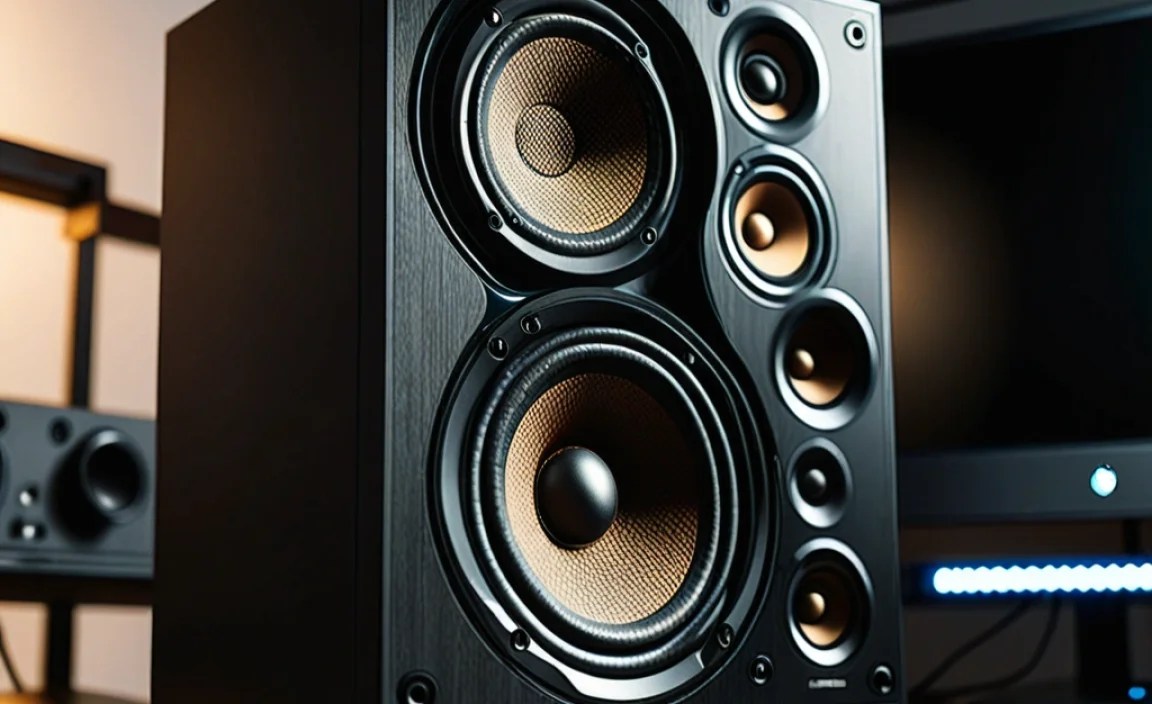
Understanding the different types of speaker setups will help you choose what’s best for your needs and desk space.
2.0 Systems (Stereo)
These systems consist of two speakers, typically placed on either side of your monitor. They handle the full range of audio frequencies – highs, mids, and lows. They are often more compact and simpler to set up. For general use, music, and lighter gaming, a good 2.0 system can be perfectly adequate and sometimes offer better clarity in the mids and highs than a budget 2.1 system where the subwoofer might overpower things.
Best for: Those with limited space, budget-conscious shoppers prioritizing clarity, music lovers who appreciate detailed mids and highs, and gamers who don’t need intense bass.
2.1 Systems (Stereo + Subwoofer)
A 2.1 system includes two smaller satellite speakers (like those in a 2.0 system) plus a separate subwoofer. The subwoofer is dedicated to producing low-frequency sounds (bass). This setup is excellent for creating a more immersive experience, especially in games and movies where explosions, engine rumbles, and deep sound effects are common. The satellite speakers can then focus on mid and high frequencies, leading to clearer dialogue and sharper details.
Best for: Gamers who want impactful bass, media enthusiasts who enjoy movies and music with strong low-end presence, and those who have a bit more desk space for the subwoofer.
Setting Up Your New Speakers
Getting your new speakers connected is usually straightforward, but knowing the common methods can save you a headache.
- Identify Your Ports: Look at the back of your PC. You’ll typically see a 3.5mm audio jack (often green), and possibly USB ports (USB-A and USB-C). Some higher-end sound cards might have RCA or optical ports.
- Connect the Audio Cable: For most speakers, this will be a 3.5mm audio cable. Plug one end into the speaker’s input and the other into your PC’s audio-out port (usually green).
- Connect Power: Some speakers draw power from the USB port, so plug their USB cable into an available port on your PC. Others will have a separate power adapter that plugs into a wall outlet.
- Enable in Windows (If Necessary): Once connected, Windows should automatically detect your speakers. You can verify this by right-clicking the speaker icon in your taskbar, selecting “Sounds,” and ensuring your new speakers are set as the default playback device under the “Playback” tab.
- Test the Sound: Play some music or a game to test that everything is working. Adjust the volume using the controls on the speakers and within your operating system.
Bluetooth Setup (if applicable)
If your speakers have Bluetooth:
- Turn on your speakers and put them in pairing mode (check the speaker’s manual for how to do this – often involves holding down a Bluetooth button).
- On your PC, go to Settings > Bluetooth & other devices.
- Click “Add Bluetooth or other device” and select “Bluetooth.”
- Your PC will scan for devices. Select your speakers from the list when they appear.
- Once paired, they should function as an audio output device, often selectable in the same “Sounds” menu mentioned above.
Comparison Table: Budget Gaming Speakers Under $100
To give you a quick overview, here’s a comparison of the speakers we’ve discussed. Prices can fluctuate, so consider these as general indicators of value.
| Speaker Model | Type | Connectivity | Key Feature(s) | Estimated Price Range ($USD) |
|---|---|---|---|---|
| Creative Pebble V2 | 2.0 Stereo | USB-C, 3.5mm | Compact, USB-C powered, great clarity | $25 – $35 |
| Logitech Z207 | 2.0 Stereo | Bluetooth, 3.5mm | Dual connectivity, stylish design | $50 – $70 |
| Micca PB42X | 2.0 Bookshelf (Powered) | 3.5mm, RCA | Exceptional audio fidelity, powerful drivers | $80 – $110 (watch for sales) |
| Edifier M2200BT | 2.1 Stereo + Subwoofer | Bluetooth, 3.5mm | Dedicated subwoofer for bass, versatile | $70 – $90 |
| TaoTronics TT-SK024 | Soundbar | 3.5mm, USB Power | Space-saving, sleek, wide soundstage for size | $40 – $60 |
Please note that prices are estimates and can vary based on retailer, region, and ongoing sales.
Audio Technologies to Note (Simply Put)
You might see terms thrown around that sound complicated. Here’s a quick, simple breakdown of a couple you might encounter:
RMS vs. Peak Power
RMS (Root Mean Square): This tells you how much power a speaker can handle continuously without damage. It’s a more reliable indicator of a speaker’s true power and volume capability. Generally, higher RMS means louder and cleaner sound at volume.
Peak Power: This is the maximum power a speaker can handle for a very short burst. It’s often exaggerated by manufacturers and less important for everyday listening than RMS.
Frequency Response
This refers to the range of sound frequencies (from very low bass to very high treble) that a speaker can reproduce. It’s measured in Hertz (Hz). A wider range (e.g., 50Hz – 20kHz) generally means a speaker can produce deeper bass and clearer treble.