
Choosing the right speakers in 2025 is all about matching your needs to the best sound technology. Look for speakers based on your primary use (music, movies, gaming), room size, and budget. Consider connection types (Bluetooth, Wi-Fi, wired) and essential features like sound quality, portability, and smart capabilities to get a great audio experience without the confusion.
Buying new speakers can feel like navigating a maze. So many options, so many technical terms! It’s easy to get lost, especially when you just want to enjoy your favorite music or get truly immersed in a movie. But don’t worry, I’m here to help. Think of me as your friendly guide through the world of audio.
This guide is for you if you’re looking to upgrade your sound system, find the perfect speakers for your gaming den, or simply want better audio for your listening pleasure. We’ll break down what really matters in speaker technology for 2025, compare different types, and help you pinpoint the best fit for your ears and your space. Let’s dive in and make your next speaker purchase a smart one!
Understanding Speaker Types: What’s Right for You?

The first step in any speaker buying journey is understanding the different kinds available. Each type is designed for specific purposes and environments. Knowing their strengths will help you narrow down your choices significantly.
Bookshelf Speakers
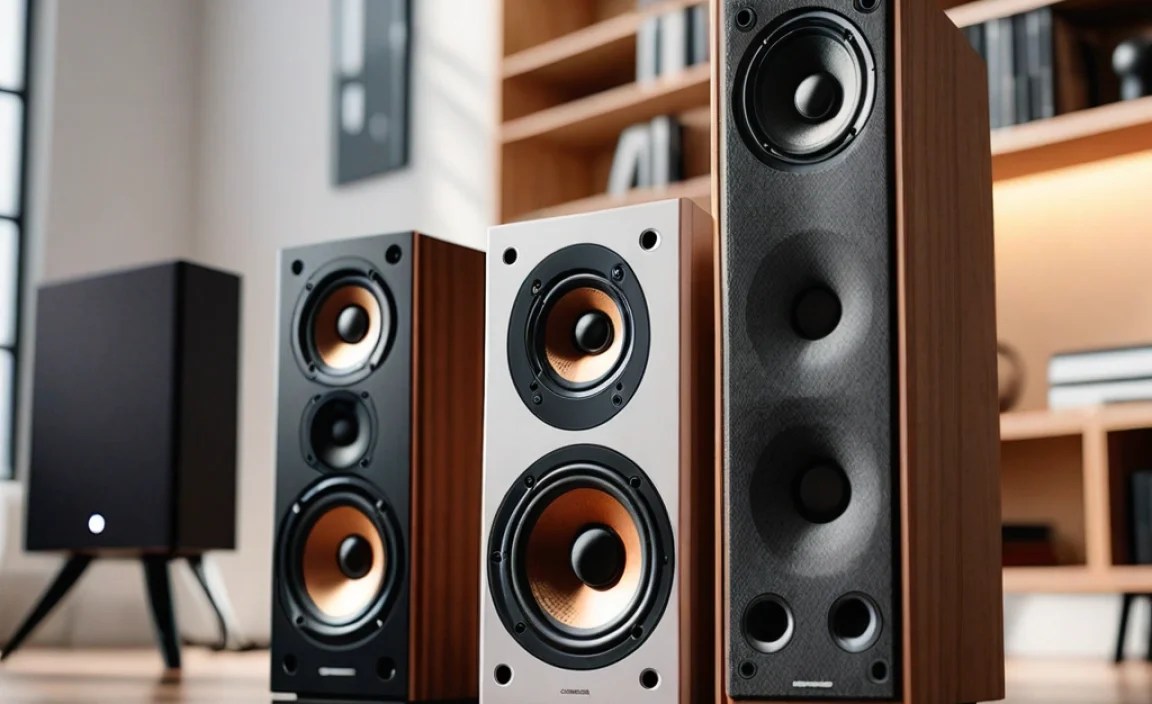
These are compact speakers, typically small enough to sit on a shelf or stand. They offer a significant upgrade over built-in TV speakers and are great for music lovers or as part of a home theater setup. Bookshelf speakers usually provide a balanced sound with good detail and can fill medium-sized rooms effectively. They often require an amplifier and a source device, offering flexibility in how you build your audio system.
Floorstanding (Tower) Speakers
As the name suggests, these speakers stand tall on the floor. They are generally larger and produce a fuller, richer sound with more bass due to their bigger drivers and cabinet size. Floorstanding speakers are ideal for larger rooms and for those who prioritize a powerful, immersive audio experience for both music and movies. Because they are self-contained, they can often be directly connected to an amplifier or receiver. For more on acoustic principles and speaker design, the Audio Engineering Society (AES) offers extensive technical papers, though for a beginner, focusing on the practical differences is key.
Soundbars
Soundbars have become incredibly popular for their simplicity and ability to dramatically improve TV audio without clutter. They are long, slim enclosures housing multiple speakers. Many soundbars come with a wireless subwoofer for enhanced bass. They are incredibly easy to set up, often connecting to your TV with a single HDMI cable. While they offer a significant improvement over TV speakers, they might not provide the same level of stereo separation or surround sound immersion as a traditional multi-speaker setup.
Portable Bluetooth Speakers
These are designed for on-the-go use. They are wireless, battery-powered, and connect to your phone, tablet, or laptop via Bluetooth. Portability is their main advantage. Sound quality can vary widely, from basic tinny output to surprisingly robust audio. They are perfect for outdoor gatherings, picnics, or simply moving music around your home. Look for good battery life, water resistance (if needed), and decent sound for their size.
Smart Speakers
Smart speakers, like those equipped with virtual assistants (e.g., Amazon Echo, Google Nest), combine audio playback with smart home capabilities. They can play music, answer questions, control other smart devices, and more, all via voice commands. Sound quality is often good for casual listening and voice interaction, but audiophiles might prefer dedicated audio systems for critical listening. Their connectivity options often include Bluetooth, Wi-Fi, and sometimes auxiliary inputs.
Home Theater in a Box (HTiB)
HTiB systems are all-in-one packages that include multiple speakers (e.g., 5.1 surround sound setup with front, center, surround speakers, and a subwoofer) and an AV receiver. They offer a convenient way to achieve surround sound without piecing together components. While they are simple to set up, the audio quality can be a step down from component-based systems, especially in lower-priced models.
Key Features to Compare in 2025 Speakers

When you start looking at specific models, there are several features that will help you compare and contrast. These are the elements that directly impact your listening experience and the speaker’s usability.
Sound Quality
This is, of course, paramount. Key aspects include:
- Clarity: How well you can distinguish individual instruments and vocals.
- Bass Response: The depth and impact of low frequencies.
- Treble: The crispness and detail of high frequencies.
- Midrange: The warmth and presence of vocals and instruments like guitars.
- Soundstage: The sense of space and the perceived width and depth of the audio.
Read reviews that describe these elements. Often, measurements like frequency response charts can be found on reputable audio sites, offering an objective look at how a speaker reproduces different sounds. For example, the Rtings.com speaker reviews provide detailed measurements and subjective sound quality assessments which are invaluable.
Connectivity Options
How you connect your speakers to your devices is crucial for convenience and sound quality.
- Bluetooth: Wireless and widely compatible, but can have slight audio compression and latency.
- Wi-Fi: Offers higher audio quality than Bluetooth and can be used for multi-room audio. Requires a home network.
- HDMI (ARC/eARC): Essential for TVs, allowing audio from the TV to be sent back to the soundbar or AV receiver. eARC offers higher bandwidth for better lossless audio formats.
- Optical/Coaxial: Digital audio inputs that are common on TVs and audio devices.
- Auxiliary (3.5mm/RCA): Analog connections, good for older devices or when digital isn’t an option.
- USB: Some speakers can play audio directly from USB drives or connect to computers.
Power Output (Wattage)
Wattage indicates how loud a speaker can get. More wattage generally means it can fill larger rooms or play louder without distortion. However, it’s not the only factor. Speaker sensitivity, cabinet design, and driver quality also play a huge role in how loud they sound and how efficiently they use power. A higher wattage isn’t always better if the sound quality at that volume is poor.
Impedance (Ohms)
Impedance is the electrical resistance of the speaker. It’s important when connecting speakers to an amplifier or receiver to ensure compatibility. Most home speakers are 4 or 8 ohms. Connecting a lower impedance speaker to an amp that isn’t rated for it can cause overheating or damage to the amplifier. Always check your amplifier’s manual for compatible impedance ranges.
Frequency Response
This tells you the range of sound frequencies a speaker can reproduce, measured in Hertz (Hz). A wider range, from low bass (e.g., 20 Hz) to high treble (e.g., 20,000 Hz), generally indicates a more complete and natural sound. Human hearing typically ranges from 20 Hz to 20 kHz.
Size and Design
Consider where the speakers will be placed. Bookshelf speakers need a surface, tower speakers need floor space, and soundbars fit under TVs. The aesthetic also matters – do you want them to blend in or be a statement piece?
Durability and Portability
For portable speakers, look for rugged build quality, water resistance (IP ratings are important here – IPX7 means it can be submerged in water for 30 minutes), and long battery life.
2025 Speaker Comparison: Top Contenders

To give you a clearer picture, let’s compare some popular speaker types based on common user needs in 2025. This isn’t an exhaustive list of specific models, but rather a comparison of categories and what to expect.
| Speaker Type | Best For | Pros | Cons | Typical Connectivity | Price Range (Approx.) |
|---|---|---|---|---|---|
| Bookshelf Speakers | Music lovers, small-to-medium rooms, stereo listening | Excellent sound quality for size, detailed audio, good value | Often require separate amplifier, might lack deep bass | Wired (speaker wire), sometimes Bluetooth/Wi-Fi options | $150 – $1000+ (per pair) |
| Floorstanding (Tower) Speakers | Large rooms, home theaters, immersive music and movie experiences | Full-range sound, deep bass, powerful output, impressive soundstage | Require significant space, generally more expensive, need powerful amplification | Wired (speaker wire) | $500 – $5000+ (per pair) |
| Soundbars | TV audio upgrade, simple home theater, living rooms | Easy setup, space-saving, significant TV sound improvement, often come with subwoofer | Limited stereo separation, less immersive surround than discrete speakers, less upgradeable | HDMI ARC/eARC, Optical, Bluetooth, sometimes Wi-Fi | $100 – $1500+ |
| Portable Bluetooth Speakers | Outdoor use, parties, travel, casual listening anywhere | Highly portable, wireless, easy to use, various price points | Sound quality can be compromised, bass can be limited, battery life varies | Bluetooth, sometimes Aux-in or Wi-Fi | $30 – $400+ |
| Smart Speakers | Voice control, smart home integration, background music, casual listening | Voice assistant features, multi-room audio potential, convenient | Sound quality may not satisfy audiophiles, privacy concerns for some | Wi-Fi, Bluetooth | $50 – $300+ |
Choosing Speakers for Specific Needs
Let’s focus on tailoring your speaker choice to your primary use case.
For Music Lovers
If your main goal is to enjoy music, especially from a dedicated listening setup, bookshelf or floorstanding speakers are likely your best bet. Look for:
- Natural Tonality: Accurate reproduction of instrument tones.
- Detailed Highs: Clear cymbals and vocal nuances.
- Balanced Midrange: Vocals should sound present and warm.
- Controlled Bass: Enough for genres that require it, but not overwhelming.
Consider pairing bookshelf speakers with a dedicated amplifier or receiver for maximum flexibility and sound quality. For larger rooms or a more impactful experience, floorstanding speakers are excellent. Brands like Klipsch, Bowers & Wilkins, and Polk Audio are often lauded for their musicality.
For Home Theater Enthusiasts
Immersive sound is key here. You’ll want speakers that can create a convincing surround sound experience.
- 5.1 (or more) Systems: These include front left/right speakers, a center channel (crucial for dialogue), surround speakers, and a subwoofer.
- Surround Sound Capabilities: Look for systems designed to handle Dolby Atmos or DTS:X if you want overhead audio effects, often with upward-firing drivers or ceiling speakers.
- Subwoofer Power: A good subwoofer adds significant impact to explosions and low-frequency effects in movies.
For simplicity, a high-quality soundbar with Dolby Atmos support can be very effective. However, a dedicated AV receiver paired with separate bookshelf, center, and surround speakers will generally offer superior performance and customization. Brands like Yamaha (for receivers), Denon (receivers), and speaker brands like Definitive Technology or SVS are often recommended for home theater setups.
For Gamers
Gaming requires precise audio cues, a wide soundstage, and the ability to react to fast-paced sound. Good gaming speakers offer:
- Clear Positional Audio: Pinpointing enemy footsteps or direction of gunfire.
- Dynamic Range: Handling both subtle environmental sounds and loud explosions.
- Low Latency: Especially important for wireless gaming.
- Immersive Soundstage: Feeling “in” the game world.
Many dedicated gaming speaker systems excel here, often featuring multiple drivers for distinct sound separation. Dedicated gaming headsets offer privacy and extreme positional accuracy. However, a good pair of bookshelf speakers connected to your PC or console can also provide a fantastic gaming audio experience. Some PC speakers offer virtual surround sound features.
For Portability and Casual Listening
If you need speakers for the beach, backyard, or just moving around the house, portability is key.
- Battery Life: How long can it play on a single charge?
- Durability: Can it handle being bumped, dropped, or exposed to the elements? Look for high IP ratings for water and dust resistance.
- Sound Quality for Size: While not equivalent to larger systems, good portable speakers can deliver surprisingly full sound.
- Connectivity: Easy pairing with Bluetooth is essential. Some offer multi-device pairing or stereo pairing for two speakers.
Brands like Bose, JBL, and Sonos (with their portable options) are popular for good reason, offering a balance of sound, durability, and features.
Connecting Your Speakers: What You Need

Once you’ve chosen your speakers, you need to consider how they’ll connect to your devices. This can involve:
- Speaker Wire: For passive bookshelf and floorstanding speakers, you’ll need to run speaker wire from the amplifier/receiver to each speaker. The gauge (thickness) of the wire can matter for longer runs to prevent signal degradation.
- HDMI Cables: For soundbars and AV receivers connecting to TVs, HDMI with ARC or eARC is the standard for ease of use and passing high-quality audio signals.
- Analog Audio Cables: If connecting older devices or some portable inputs, you might use 3.5mm stereo mini-jack cables or RCA cables.
- Power Adapters: Active speakers and soundbars, as well as AV receivers, will require a power source from a wall outlet.
- Subwoofer Cables: If using a separate passive subwoofer with an AV receiver, you’ll need a subwoofer cable (often an RCA cable). Wireless subwoofers connect via their own power adapter and a wireless transmitter/receiver.
For information on cable types and their uses, resources like Sound & Vision magazine often provide helpful connectivity diagrams and explanations.
Tips for a Better Listening Experience
It’s not just about the speakers; placement and setup play a huge role!
- Speaker Placement: For stereo speakers, aim for an equilateral triangle setup where you are at one point, and the two speakers form the other two points. Keep them at ear level if possible. For surround sound, follow your system’s guidelines (e.g., NHT has great guides on speaker placement).
- Room Acoustics: Hard surfaces like bare walls and floors can cause echoes and reflections that degrade sound. Soft furnishings like rugs, curtains, and upholstered furniture can help absorb sound and make it clearer.